
 Indigenous Panamanians fail to benefit from country's
growing wealth and dispute notion that money
equals riches.
Indigenous Panamanians fail to benefit from country's
growing wealth and dispute notion that money
equals riches.
aljazeera | 09 Apr 2016 10:25 GMT |
Stephanie Ott
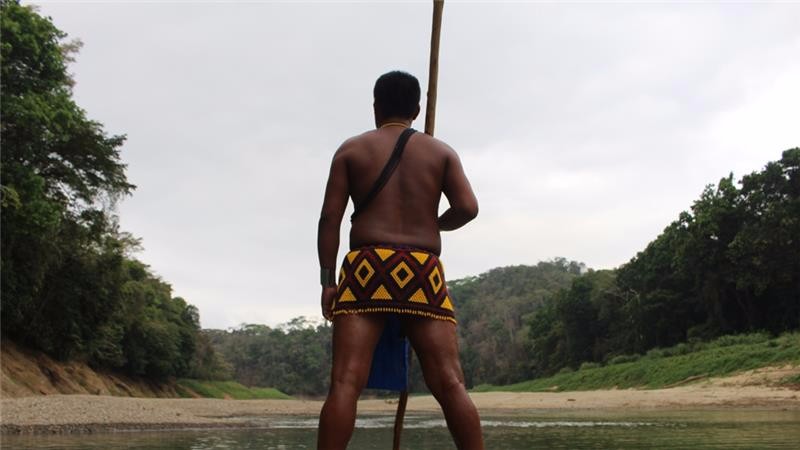 'Life is simpler here. It's too fast in the city,' says
Celso [Stephanie Ott/Al Jazeera]
'Life is simpler here. It's too fast in the city,' says
Celso [Stephanie Ott/Al Jazeera]
STORY HIGHLIGHTS
Facts
- Around 12.7 percent of the population of Panama is indigenous
- Many live in rural areas and lack access to water, healthcare and sanitation
- Poverty among the indigenous population is above 70 percent
- Extreme poverty is above 40 percent
Panama City, Panama – Celso stands on the tip of a canoe, looking out into the Panamanian rainforest.
He steers the boat along the shallow river that weaves through Chagres National Park.
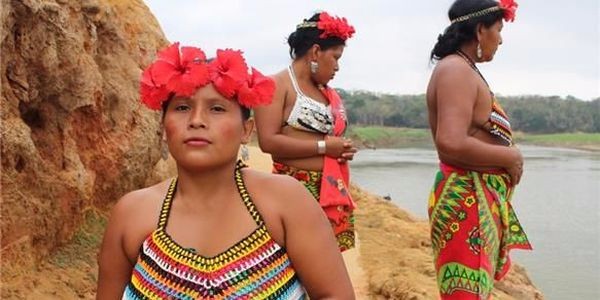
The 25-year-old is a member of the Embera, one of Panama’s seven indigenous tribes.
“Some Indians move to the city, but many come back,” he says.
“Life is simpler here. It’s too fast in the city.”
Celso went to high school in the capital for four years, but decided to return to his village, where his seven brothers live.
“I prefer living here. We are freer than the people in the city,” he says.
Just an hour’s drive south lies busy Panama City. There, seemingly worlds away from Celso’s village, glass and steel skyscrapers line the harbour front, home to the offices of multinational firms.
Right in the heart of the capital is the office of a law firm that is at the centre of the biggest leak of confidential financial data in the history of journalism: Mossack Fonseca. The so-called Panama Papers exposed a global web of 214,000 offshore shell companies, involving heads of state, athletes, financial institutions and criminals.
Around 8 percent of global financial wealth – approximately $7.6 trillion – is held in tax havens such as Panama, according to Gabriel Zucman, the author of The Hidden Wealth of Nations: the Scourge of Tax Havens.
Clemens Fuest, the president of the Ifo Institute for Economic Research, says: “The fact that there are offshore companies and that some are used for illegal activities like tax evasion and money laundering is known. Panama is not the only tax haven.”
Panama’s indigenous population
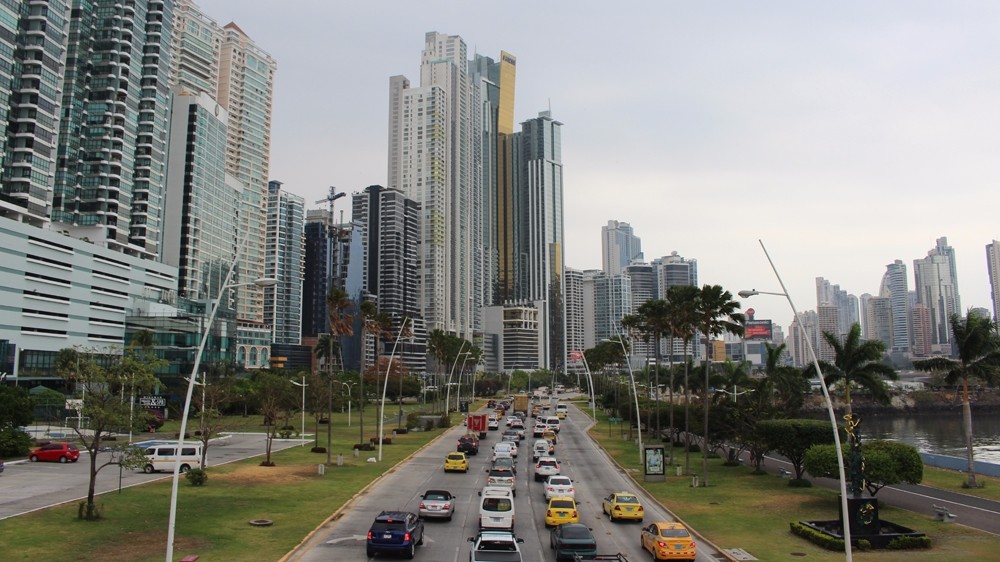 Panama’s GDP grew by 6.2 percent in 2014, according to the World Bank, and the country has been one of the fastest-growing economies in Latin America, due to infrastructure projects such as the $5.3bn Panama Canal expansion, to be completed this year, and foreign direct investments. But according to Fuest, the local population barely profits from the rising wealth.
According to the International Work Group for Indigenous Affairs, around 12.7 percent – around half a million people – of the total population are indigenous, and many live in rural areas and lack access to water, healthcare and sanitation.
A recent World Bank study on indigenous communities in Latin America found that they benefit less from economic growth in their countries and are more likely to be poor.
According to Osvaldo Jordan of the Panamanian NGO Alianza para la Conservacion y el Desarrollo, indigenous people who move to urban areas often work in low-paid jobs. “There is prejudice and discrimination against them among the Spanish-speaking Latin population. Some think the Indians are less intelligent, which damages their self-esteem,” he explains.
Despite Panama’s booming economy, poverty among the indigenous population is above 70 percent.
But while some measure wealth in financial assets, many indigenous people consider themselves rich because they have a connection to nature and have managed to protect their culture.
“The idea of Indians being among the poorest is complicated,” explains Mark Camp, the deputy executive director of Cultural Survival, a US-based NGO that supports the rights of indigenous peoples worldwide.
“It’s certainly true that when you look at the different measures of wealth and poverty, indigenous peoples end up falling to the bottom of the ranking. However, they often are offended by having their wealth judged only by those measures that were established by Western standards.”
[gallery_bank type=”images” format=”thumbnail” title=”false” desc=”false” responsive=”true” special_effect=”overlay_fade-white” animation_effect=”rollIn” album_title=”true” album_id=”975″]
Celso walks barefoot through the dense jungle. “I know this land inside out,” he says, smiling.
The Embera live in thatched-roof houses on stilts and travel in dugout canoes along the Chagres River. They have their own language, are famous for their beadwork and some paint their skin with fruit juice dye jagua.
The Embera have sovereignty over the land because the government designated it as indigenous territory, called comarca indigena. There, tribes have their own administrative and judicial system. The Kuna, another community, has full autonomy over its land, Guna Yala, an archipelago also known as San Blas. A border divides Guna Yala and Panama and – in an attempt to limit tourism – visitors have to show their passport and need authorisation to visit.
However, some indigenous communities do not own the land they live on, as their territory hasn’t been officially recognised as indigenous.
Members of Panama’s largest indigenous group, the Ngobe, are currently embroiled in a land ownership dispute with the Panamanian government. Around 1,000 Ngobe who lived in the Bocas del Toro province say they had to leave their homes behind when AES Changuinola, an affiliate of the energy giant AES Corporation, started building the Chan-75 hydroelectric dam there.
They claim that Panama, which adopted the UN Declaration on the Rights of Indigenous Peoples in 2007, never obtained their consent for the construction.
The dam was completed in 2011 and their villages are now deep underwater. In seeking compensation from the government for the loss of their land, crops and housing, Ngobe members spoke in front of the Inter-American Human Rights Commission in Washington DC on April 7.
What does it mean to be indigenous in a modern world?
Bernardino Morales, 28, a Ngobe, gave his testimony about what he sees as unlawful encroachment of his homeland, which is rich in mineral deposits. He had to leave his farm because of the dam. “Our life has changed drastically after the construction. It’s painful for us and it has created resentment,” he said. He now lives with his mother, wife and one-year-old daughter in Valle de Risco, a Ngobe village.
Morales sees the struggle for land rights and getting the government to demarcate indigenous territory as their biggest challenge. “I don’t know whether our land dispute will get resolved any time soon. Not just my family, but a lot of people I know face an uncertain future.”
Camp, whose organisation supports the Ngobe, explains: “We want to set a precedent, especially as other dams are being planned right now.”
A lot has changed since Celso was a boy. Solar panels now provide his village with electricity.
But deforestation, climate change, infrastructure, mining and hydroelectric projects pose threats to the natural habitats of indigenous communities.
In recent years tourism has emerged as a major source of income for some tribes.
Meanwhile, many indigenous people move to urban areas, mostly Panama City, in search of jobs and education.
“People want to hold on to their own culture, language and connection to nature, but that doesn’t mean that they are rejecting modernity and technology,” Camp explains. “Just because you move back to the comarca [home district] doesn’t mean you’re moving back without a cellphone and a Facebook page. You can do both.”
Yet “it’s difficult to defend the lifestyle of your parents when you see how much the world is changing,” adds Jordan. “The question is, ‘What does it mean to be indigenous in a modern world?'”
For indigenous Panamanians, it is important to find a balance between protecting their traditions, sovereignty and the biodiversity of their homeland and the modernity that comes hand in hand with a changing world.
“Maybe I want to live in the US one day,” Celso says, pointing out over the riverbank, as young children splash in shallow water holes.
“But this land is my home.”
People want to hold on to their own culture, language and
connection to nature,' says Mark Camp of Cultural
Survival [Stephanie Ott/Al Jazeera]
Source: Al Jazeera’
Content on this website is for general information purposes only. Your comments are provided by your own free will and you take sole responsibility for any direct or indirect liability. You hereby provide us with an irrevocable, unlimited, and global license for no consideration to use, reuse, delete or publish comments, in accordance with Community Rules & Guidelines and Terms and Conditions.
1 Comment
the_ararar
fact is, exiting their poverty by e.g. urbanizing will mean abandoning their culture and being eventually assimilated, especially language-wise.
They are poorer than the rest of the population because they don’t benefit from cities and trade as much as them, and if they start doing so, they’ll lose their traditional lifestyle.
FEATURED
Traumatised Afghan refugees fear deportation from EU
Human Rights, War & Conflict, Europe
Private asylums in Sweden benefit from refugee crisis
Panama Papers: Why some of this is perfectly legal
Discover more from iloveithaki.gr
Subscribe to get the latest posts sent to your email.