Sponsor preparing to launch the tanker ‘Empire Coral’ built by Sir James Laing & Sons Ltd, Sunderland, 11 February 1941 – Sunderland launches (63 images)via Travel and Leisure.com
viaTrevor Corson (author of The Secret Life of Lobsters) – Brett Westwood looks at how the lobster is a creature that when drawn up from the deep is made to shed its natural identity as an ancient predator of the sea floor and has become an improbable sex symbol. Listen on the BBC
Silent film’s most iconic version of Bram Stoker’s 1897 novel “Dracula” was F.W. Murnau’s 1929 film “Nosferatu,” which starred Max Schrek as the vampire. (Kino International)
Today is the day Dracula arrived in Whitby, according to the novel by Bram Stoker.
The commemorative bench records Bram Stoker’s link to the sleepy Yorkshire seaside town
LIFE Magazine Archives – Hippies and houseboats; they seem to go together almost like wine and cheese. At least, they used to, especially in California in the 1960s when a mix of old beatniks and young hippies formed a community of whimsical water homes in the Bay Area.
Gate 5 (is a) houseboat community on the site of a WWII era ship building company in Richardson Bay, Sausalito. After the war, thousands of people flooded into the waterfront area to work in the new shipyards. Housing was scarce, but since they were building ships anyway, the laborers got crafty and began salvaging materials from old boats to create their own make-shift homes.
Wayne with his parrot, Normal-Norman Calin, Michael Scott in the center and unidentified man on the right, #10, Gate 5, Sausalito, California, 1970
Not soon after, struggling artists and hippies got wind of the alternative lifestyle and liked what they saw. keep reading
New Docks, Southampton, 16 August 1959
The SS Nevasa, also known as HMT Nevasa, was a British troopship built on the River Clyde, Scotland, in 1955; owned by the British India Steam Navigation Company and was 20,527 tons. New features of the ship included stabilisers to reduce rolling in rough seas.
The end of National Service conscription in 1961 led to the SS Nevasa being withdrawn from service. The ship was laid up in the River Fal until 1965 when it was converted to an educational cruise ship. The Oil crisis of 1973/74 and its effect on running costs led to the ship’s final cruise in December 1974. Pictures from earlier cruises
HMAS Australia at Fremantle, 1919
A Sopwith 1½ Strutter launching from one of Australia’s turrets. MORE
HMAS Australia was one of three Indefatigable-class battlecruisers built for the defence of the British Empire. Ordered by the Australian government in 1909, launched in 1911, commissioned as flagship of the fledgling Royal Australian Navy (RAN) in 1913, and the only capital ship ever to serve in the RAN.
On her return to Australian waters, several sailors aboard the warship mutinied after a request for an extra day’s leave in Fremantle was denied.
Post-war budget cuts saw her role downgraded to that of training ship before she was placed in reserve in 1921. Disarmament provisions of the Washington Naval Treaty required the destruction of Australia as part of the British Empire’s commitment, and she was scuttled off Sydney Heads in 1924. More on wikipedia
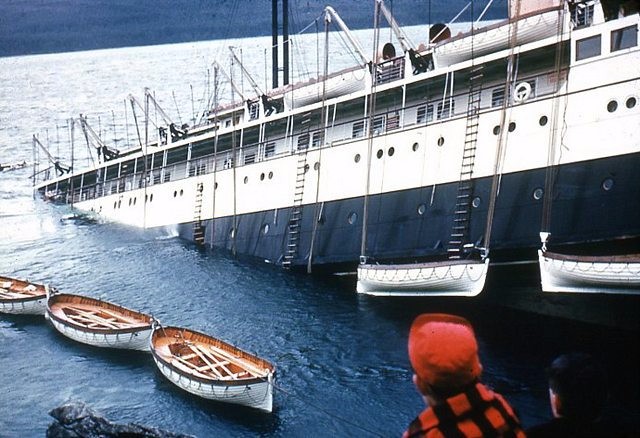
The Princess Kathleen, 1952 Lena Point – ran aground during low tide about 18 miles north of Juneau, Alaska. Everyone was rescued. As the tide came back in, she slipped under the surface and has since become a great place to dive.
SS Princess Kathleen (built 1924) was a passenger and freight carrier owned and operated by Canadian Pacific Steamships. She served the coastal communities of British Columbia, Alaska, and Washington. more on wikipedia
Bow view of the icebreaker Ermack in the ice; built on the Tyne at the Walker Yard by Vickers Armstrong & Co Ltd.
Yermak (sometimes spelled Ermak) was a Russian and later, Soviet icebreaker, (the first polar icebreaker in the world) having a strengthened hull shaped designed to ride up over and crush, rather than split, pack ice. (up to 2m (6 feet) thick) Between 1899–1911 Yermak sailed in heavy ice conditions for more than 1000 days.
Yermak was built for the Imperial Russian Navy and launched in 1898; named after the famous Russian explorer Don Cossack Yermak Timofeyevich. Yermak served with different branches of the Russian and Soviet Navy and Merchant Marine up until 1964, becoming one of the longest-serving icebreakers in the world. wikipedia
Icebreaker Ermack assisting the battleship Apraxin in the iceA trowel placed in a Native American oyster midden that dates to about 1,000 years ago shows the relative size of the shells. The average size of modern oysters is significantly smaller. (Torben Rick, NMNH)
Comparisons between the oyster population of today to the past has been mostly conjecture—until now. A new research paper details the first broad study of historical oyster populations throughout the history of the world’s largest estuary. This could be a major tool for researchers and policy-makers to use in the course of restoring the bay’s health.
Higher historical numbers of oysters had been presumed, but not proven. “For years people have been saying that,” says Torben Rick, director and curator of North American archaeology at the Smithsonian’s National Museum of Natural History and lead author of the paper. “A lot of it is just anecdotal. When John Smith came through, he said oysters were everywhere. They were a hazard to ships.” keep reading on Smithsonian
Illegal oyster harvesting (dredging at night) – Harper’s Weekly, The Oyster War in Chesapeake Bay (March 1, 1884) Foreign boats included Conntecticut watermen who moved into the Chesapeake after overharvesting the beds in Long Island Sound, and also boats from across the state line. The “Oyster Wars” had broken out between Maryland and Virginia.Johan van Oldenbarnevelt; September, 1949 in Holland
The TSMS Lakonia was a Greek-owned cruise ship which caught fire and sank north of Madeira on December 22, 1963, with the loss of 128 lives. The vessel was built in the Netherlands as the MS Johan van Oldenbarnevelt (Launched: 3 August 1929) and sailed regularly between Amsterdam and the East Indies. The ship served as an allied troopship during World War II, then was sold to the General Steam Navigation Company of Greece in 1962.
Renamed Lakonia, the ship completed a successful cruise from Southampton to the Canary Islands in April 1963. On December 19, she departed Southampton for an 11-day Christmas cruise with 646 passengers and 376 crew. On the fourth evening of the voyage, a steward found the ship’s hair salon ablaze, with flames spreading quickly toward the passenger cabins. keep reading on wikipedia
World War I – Commander in Chief of the Atlantic Fleet Admiral Henry T. Mayo
Henry Thomas Mayo (Burlington, Vermont, 8 December 1856 – 23 February 1937, Portsmouth, New Hampshire) – graduated United States Naval Academy in 1876, Appointed rear admiral in 1913, he commanded the naval squadron involved in theTampico Incident of 9 April 1914. Promoted to vice admiral in June 1915, as the new Commander in Chief, Atlantic Fleet, he received the rank of admiral 19 June 1916. In 1940, the destroyer USS Mayo (DD-422) was named in his honor.
Soldiers, sailors, airmen and Marines like to have good-natured fun at each others’ expense. The distinct mentalities between the branches can create real problems.
Outwardly, the so-called “Special Forces Advisor’s Reference Book” focuses on the complexities of working with foreign troops, civilians and non-governmental organizations. But tucked away near the end of the main text, the authors included a detailed section on the “service culture” of other U.S. troops.
In short, the Army is great, according to the handbook. But the Marines are elitists who think they’re better than everyone else. The Air Force is dominated by pilots who believe they can win wars with technology alone. And the Navy is full of hidebound traditionalists who are resistant to change.
Soviet space program satellite tracking ship Cosmonaut Vladimir Komarov entering Willemstad; Curaçao, Netherlands Antilles, August 1974. Originally built as an ordinary cargo ship in 1966; converted in Leningrad in 1967; decommissioned 1989. wikipedia
Soviet Union 1964 postage stamp commemorating Vladimir Mikhailovich Komarov
Named after Vladimir Mikhaylovich Komarov, a cosmonaut who died on Soyuz 1. Launched into orbit on 23 April 1967 carrying cosmonaut Colonel Vladimir Komarov, Soyuz 1 was the first crewed flight of the Soviet space program. The flight was plagued with technical issues, and Komarov was killed when the descent module crashed into the ground due to a parachute failure; the first in-flight fatality in the history of spaceflight. wikipedia
Found photo – Skirting Precipitous Cliffs Along Lyngenfjord, Norway
HMS Defiance (1861) – the last wooden line-of-battle ship launched for the Royal Navy. She never once saw service as a wooden battle ship, and in 1884 she became the Devonport torpedo and mining schoolship. She was sold on 26 June 1931 to Castle’s Shipbreaking Yard for dismantling at Millbay, Plymouth. Doige’s Annual for 1932 poignantly describes her as “the last of England’s Wooden Walls”.
Ship’s figureheads at Castle’s Shipbreaking Yard; London; 1900’s
Whitbread public house: exterior, 1972
With over 150,000 pictures now mapped across the city, a new digital photo archive of the city of London is so rich in content it’s almost too much to cope with. Launched last week, Collage, The London Picture Map allows you to trace London’s visual history street by street.
It’s the result of two full years of digitizing and mapping images from the London Metropolitan Archive and the Guildhall Art Gallery, which together possess the largest collection of London images in the world. A few clicks will lead you directly to tens of thousands of photos, paintings, drawings and historic posters.
found photo – CDV photo captioned “M. Day of Devonport” c. 1970’sLeaving the busy English port of Southampton in 1938 aboard the “Queen Mary”Handsome Nitrate Clipper Princess Eitel Friedrich – Three masted full-rigged sailing ship at anchor. The ship was built in Hamburg and is now a museum ship at Gdynia, Poland. Other names for the ship are: Colbert, Pomorze, Dar Pomarza. State Library Victoria Collections
The Dar Pomorza is a Polish full-rigged sailing ship built in 1909 which is preserved in Gdynia as a museum ship. She has served as a sail training ship in Germany, France, and Poland. The ship was built in 1909 by Blohm & Voss and dedicated in 1910 by Deutscher Schulschiff-Verein as the German training ship Prinzess Eitel Friedrich. Following World War I, the ship was taken as war-reparations by Great Britain and brought to France, where she was assigned to the seamen’s school at St-Nazaire under the name “Colbert”. Nicknamed the “White Frigate” and during World War II she was interned in Stockholm. more on wikipedia
Freighters Taking on Ore at Duluth, MN. Original (3243 x 2674)American Civil War: crew of the USS Hunchback
Ship’s officers and crew on deck, in the James River, Virginia, 1864-65. Photographed by Matthew Brady. One man is playing the banjo in the foreground, another is holding a small white dog, while others are reading newspapers. Men seated in center appear to be peeling potatoes. Many crewmen are wearing their flathats in the style of berets. About a fifth of this ship’s crew appear to be African-Americans. The original photograph has Brady negative number B-2011. U.S. Naval History and Heritage Command Photograph.
Of more than 600 ships that served in the U.S. Navy during the Civil War, Hunchback is one of the most photographed.
Hunchback and Howitzers – Hampton Roads Naval Museum – more images
USS Hunchback was a side-wheel, steam-powered gunboat used by the United States Navy during the American Civil War. Built in New York City in 1852 for civilian use as a ferry. United States Navy purchased the boat on 16 December 1861. keep reading on wikipedia
Civil War Photo Friday: Crewmen from the USS Hunchback
After one final mission in April up the Chowan River, the Navy sent the ship back to New York Harbor, where it was decommissioned on 12 June 1865. A month later, the ship was sold to the Brooklyn and New York Ferry Company for civilian use. The boat was renamed the General Grant and remained in civilian use until approximately 1880, when she was retired and scrapped. wikipedia
U-1206; PopularMilitary
On April 6, 1945, a German navy submarine named the U-1206 departed from the port city of Kristiansand, in Nazi-occupied Norway, and began its first combat patrol. Assigned to the waters of the North Atlantic, its mission was to seek out and destroy British and American ships on the high seas.
For the 50-man crew aboard submarines like the U-1206, life wasn’t just extremely dangerous, it was also very unpleasant: Quarters were cramped, and the bathrooms were no exception.
από τους αρχαίους ιλλυριούς και τον πύρρο στους σημερινούς αγώνες για δικαιοσύνη και αξιοπρέπεια.
έλληνες και αλβανοί — αιώνες πολέμων, συνεργασίας και συνύπαρξης....
από τους αρχαίους ιλλυριούς και τον πύρρο στους σημερινούς αγώνες για δικαιοσύνη και αξιοπρέπεια.
έλληνες και αλβανοί — αιώνες πολέμων, συνεργασίας και συνύπαρξης....



 California Dreaming on the Last Hippie Houseboats


Soldiers, sailors, airmen and Marines like to have good-natured fun at each others’ expense. The distinct mentalities between the branches can create real problems.